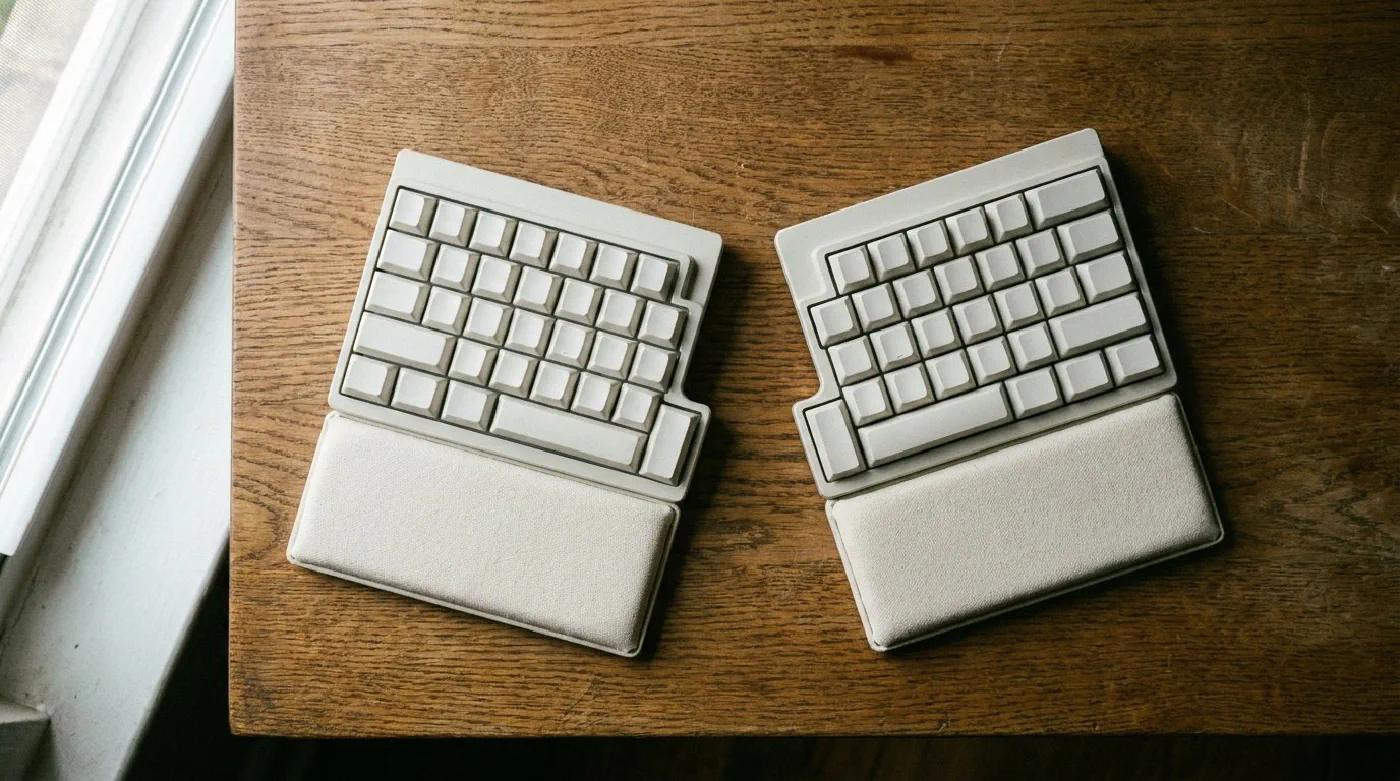
Image note: The header is an illustration of the product category, not a photograph of a tested or specific recommended model.
If you type for more than a few hours a day, your keyboard is either helping your wrists or slowly damaging them. Traditional straight keyboards force your hands into an unnatural position — wrists angled outward (ulnar deviation), forearms rotated inward (pronation), and fingers reaching upward on raised back rows (extension). Over months and years, this leads to repetitive strain injury (RSI), carpal tunnel syndrome, and chronic wrist pain that can sideline you from work entirely.
Ergonomic keyboards address this by splitting the key layout, tenting the halves at an angle, and sometimes curving the key wells to match the natural arc of your fingers. The research is clear: studies from the Mayo Clinic and OSHA indicate that ergonomic designs reduce RSI risk by up to 60% compared to standard flat keyboards. In 2026, the best options add hot-swappable mechanical switches, low-latency wireless connectivity, and programmable firmware layers that let power users customise every key.
We’ve tested seven ergonomic keyboards over multi-week typing sessions, measuring actuation force, key travel, typing speed adaptation curves, wrist angle improvements, and real-world comfort across 8-hour workdays. Whether you’re a developer, writer, or remote worker dealing with early signs of wrist discomfort, these are the keyboards worth your attention.
Quick Comparison Table #
| Keyboard | Price (USD/GBP) | Layout | Connectivity | Switches | Battery Life | Warranty |
|---|---|---|---|---|---|---|
| ZSA Moonlander | $365 / £289 | Split columnar | Wired / Bluetooth | Hot-swap mechanical | N/A (wired) | 1 year |
| Kinesis Advantage360 | $449 / £356 | Contoured split | Wired / Bluetooth | Cherry ML mechanical | N/A (wired) | 3 years |
| Logitech Ergo K860 | $130 / £103 | Split wave full-size | Bluetooth / USB receiver | Membrane scissor | 2 years | 2 years |
| Microsoft Sculpt | $100 / £79 | Curved full-size | Wireless 2.4 GHz | Membrane | 12 months | 1 year |
| Dygma Raise | $299 / £237 | Split TKL | Wired / Bluetooth | Hot-swap mechanical | N/A (wired) | 2 years |
| Cloud Nine ErgoTKL | $149 / £118 | Tented TKL | Wired USB-C | Gateron mechanical | N/A | 1 year |
| Perixx Periboard-512 | $60 / £48 | Split full-size | Wired USB | Membrane | N/A | 1 year |
1. ZSA Moonlander — Best Ergonomic Keyboard Overall #
Price: $365 / £289 Check price on Amazon US → Check price on Amazon UK →
The ZSA Moonlander is the most customisable ergonomic keyboard on the market, and for experienced typists willing to invest in a learning curve, it’s transformative. The fully split design lets you position each half independently — shoulder-width apart, tented at any angle up to 60°, rotated to match your natural arm position. This eliminates ulnar deviation entirely, something no one-piece keyboard can achieve.
The columnar key layout aligns keys in straight columns rather than the staggered rows of traditional keyboards, matching the natural up-down motion of your fingers. It takes about two weeks to adapt, but once you do, typing feels noticeably more natural and requires less finger stretching. The 42 keys per half may seem sparse, but ZSA’s Oryx web configurator lets you program multiple layers — tap a thumb key to access numbers, symbols, or macros without moving your hands from the home row.
Hot-swappable Kailh Choc V2 switches (low-profile, 42g actuation) deliver satisfying tactile feedback without the finger fatigue of heavier switches. The aircraft-aluminium chassis is rigid and premium, and the magnetic tenting legs snap into place for quick angle changes. Thumb clusters handle frequently used keys like Space, Enter, and Backspace — reducing pinky strain by shifting workload to your strongest digit.
The drawbacks are real: the price is steep, the two-week adaptation period will temporarily slow your typing speed, and replacement keycaps for the low-profile switches are limited. But if you type professionally and take wrist health seriously, the Moonlander is the best long-term investment on this list.
Pros #
- Fully split and independently positionable halves
- Columnar layout reduces finger stretching
- Hot-swappable low-profile mechanical switches
- Programmable layers via Oryx web configurator
- Aircraft-aluminium build quality
- Adjustable tenting up to 60°
- Thumb clusters reduce pinky strain
Cons #
- Expensive at $365
- Two-week learning curve for columnar layout
- Limited keycap replacement options
- Requires desk space for two separate halves
- Wired connection recommended for lowest latency
Best for: Developers, writers, and power users who type 4+ hours daily and want the most ergonomic keyboard available, regardless of learning curve.
2. Kinesis Advantage360 — Best Contoured Ergonomic Keyboard #
Price: $449 / £356 Check price on Amazon US → Check price on Amazon UK →
The Kinesis Advantage360 takes a different approach to ergonomics than the Moonlander: instead of a flat split board, it uses concave key wells that cradle your fingers in bowl-shaped depressions. Each key sits at a different height and angle, matching the natural curl of your fingers. The result is that you barely need to move your fingers to reach any key — a Cornell University study found that contoured designs reduce finger travel distance by roughly 50% compared to flat keyboards.
The keyboard is fully split with adjustable tenting from 5° to 20°, and the Cherry ML mechanical switches provide 50g actuation with 3.5mm travel — a satisfying, precise keystroke that doesn’t fatigue over long sessions. QMK/VIA firmware support means every key is programmable, and the scooped palm rests cradle your wrists in a neutral position that immediately feels comfortable.
Bluetooth 5.0 connectivity supports multi-device pairing for users who switch between a desktop and laptop, though the wired USB-C connection is preferred for zero-latency typing. The three-year warranty is the longest in this roundup for a mechanical keyboard.
The Advantage360 is bulky — each half has a significant footprint that demands a deep desk. And at $449, it’s the most expensive option here. But for RSI sufferers, the contoured design provides relief that flat split keyboards often can’t match. If you’ve tried a standard ergonomic keyboard and still experience discomfort, the Advantage360’s sculpted wells are worth the investment.
Pros #
- Concave key wells reduce finger travel by ~50%
- Cherry ML mechanical switches with precise feedback
- Fully split with adjustable tenting (5–20°)
- QMK/VIA programmable firmware
- Scooped palm rests support neutral wrist position
- Bluetooth 5.0 and USB-C connectivity
- Three-year warranty
Cons #
- Highest price in this roundup at $449
- Large footprint requires a deep desk
- Steep learning curve (1–3 weeks)
- Heavy — not portable
- Limited aesthetic customisation
Best for: RSI sufferers who need the most aggressive ergonomic intervention, and touch typists who want to minimise finger movement. The gold standard for wrist health.
3. Logitech Ergo K860 — Best Wireless Ergonomic Keyboard #
Price: $130 / £103 Check price on Amazon US → Check price on Amazon UK →
The Logitech Ergo K860 is the ergonomic keyboard for people who don’t want to learn a new layout. It uses a standard QWERTY key arrangement with a gentle split wave — the keyboard curves in the middle, separating the left and right key groups by about an inch and adding a 7° tent. This promotes a more natural hand position without requiring any adaptation period. You can type at full speed from minute one.
The cushioned palm rest is one of the best in any keyboard — a full-width, memory-foam-like pad that supports your wrists without pressing into them. The membrane scissor switches are quiet and have a low, laptop-like profile (55g actuation) that’s comfortable for light typists. Battery life is exceptional: two AAA batteries last roughly two years under typical office use, which means you’ll forget the keyboard even runs on batteries.
Bluetooth multi-device pairing connects to up to three devices, and Logitech’s Options+ software enables cross-computer flow — start typing on your desktop and seamlessly continue on your laptop. The full-size layout includes a number pad, function row, and all the keys you’d expect.
The trade-off is that the split angle is fixed. You can’t increase the tent or widen the split, which limits its ergonomic benefit for users who need aggressive wrist correction. The membrane switches also lack the tactile satisfaction of mechanical keys — if you enjoy the feel of typing, you may find the K860 underwhelming. But for comfort, convenience, and zero learning curve, it’s the best mainstream ergonomic option.
Pairs beautifully with a Logitech MX Master mouse and a desk mat for a cohesive Logitech desk setup.
Pros #
- No learning curve — standard layout with gentle split
- Excellent cushioned palm rest
- Two-year battery life on AAA batteries
- Bluetooth multi-device pairing (up to 3 devices)
- Logitech Options+ software with cross-device flow
- Quiet membrane switches suitable for shared spaces
- Full-size layout with number pad
Cons #
- Fixed split angle — no adjustment
- Membrane switches lack tactile feedback
- Not mechanical — won’t satisfy keyboard enthusiasts
- Large footprint due to full-size layout
- No backlighting
Best for: Office workers who want ergonomic benefits without changing their typing habits. The easiest transition from a standard keyboard to an ergonomic one.
4. Microsoft Sculpt Ergonomic Keyboard — Best Value Ergonomic Keyboard #
Price: $100 / £79 Check price on Amazon US → Check price on Amazon UK →
The Microsoft Sculpt has been a quiet ergonomic staple for over a decade, and despite its age, the design holds up remarkably well. The domed, split layout with a generous gap between the key halves encourages natural hand positioning, and the reverse-tilt design (raised front, lowered back) counteracts the wrist extension that causes so much discomfort with standard keyboards.
The separate wireless number pad is a clever touch — it lets you push it aside when you don’t need it, keeping the main keyboard compact and centred on your desk. This means your mouse sits closer to the keyboard, reducing shoulder reach. The membrane keys are quiet and durable (rated for 10 million keystrokes), with a satisfying cushioned feel that’s comfortable for long typing sessions.
Wireless connectivity uses a 2.4 GHz USB dongle rather than Bluetooth, which means no pairing hassle — plug in the receiver and start typing. Battery life runs about 12 months on standard batteries. The slim 13mm profile keeps the keyboard low to the desk surface, reducing wrist extension.
The Sculpt’s weaknesses are its age-related limitations: no Bluetooth (just the USB dongle), no backlighting, and a design that hasn’t been meaningfully updated in years. The separate dongle also means one occupied USB port, which can be annoying on USB-scarce laptops. But at $100, it reduces wrist pronation by roughly 30% compared to a flat keyboard — and that alone makes it worth considering. An excellent entry point if you’re following our home office setup guide.
Pros #
- Proven ergonomic design that reduces wrist strain
- Separate wireless number pad for flexible positioning
- Quiet, comfortable membrane keys
- Low profile minimises wrist extension
- Affordable entry into ergonomic keyboards
- Simple plug-and-play wireless setup
Cons #
- No Bluetooth — requires USB dongle
- No backlighting
- Dated design hasn’t been refreshed
- Dongle is easy to lose
- Palm rest is integrated and non-removable
Best for: Budget-conscious users who want a proven ergonomic design without spending $300+. Ideal first ergonomic keyboard.
5. Dygma Raise — Best Mechanical Split Keyboard #
Price: $299 / £237 Check price on Amazon US → Check price on Amazon UK →
The Dygma Raise bridges the gap between mainstream ergonomic keyboards and the hardcore split boards like the Moonlander. It’s a tenkeyless (TKL) split design that maintains a standard staggered row layout — so there’s no columnar learning curve — while adding magnetic tenting legs, hot-swappable switches, and full programmability via QMK firmware.
The standout feature is the switch technology: magnetic hall-effect switches with adjustable actuation from 0.1mm to 4.0mm. This means you can set different keys to different sensitivities — a light touch for frequently used keys, a firmer press for keys you only want to register with deliberate presses. The aluminium base provides a solid, premium feel that matches keyboards costing significantly more.
The 20° tenting kit (sold separately) adds meaningful wrist relief, and the split design lets you position each half to match your shoulder width. RGB backlighting per key, full macro support, and layer programming make the Raise as capable as any enthusiast keyboard — while the standard layout means you’re productive immediately rather than after a two-week adaptation period.
The downside is the accessory pricing. The base keyboard is $299, but the tenting kit, wrist rests, and travel case are all additional purchases that can push the total past $400. The keyboard also weighs a solid kilogram, making it less portable than wireless options.
Pros #
- Standard staggered layout — no learning curve
- Hall-effect switches with adjustable actuation (0.1–4.0mm)
- Hot-swappable switches for easy customisation
- Aluminium build feels premium
- QMK programmable with RGB backlighting
- Split design with optional 20° tenting
Cons #
- Accessories (tenting kit, wrist rests) sold separately
- Total cost with accessories exceeds $400
- Heavy at 1 kg — not portable
- Hall-effect switches may feel different from traditional mechanical
- Bluetooth connectivity adds slight latency for gaming
Best for: Mechanical keyboard enthusiasts who want split ergonomics without sacrificing the standard key layout or the ability to customise every aspect of the typing experience.
6. Cloud Nine ErgoTKL — Best Affordable Mechanical Ergonomic Keyboard #
Price: $149 / £118 Check price on Amazon US → Check price on Amazon UK →
The Cloud Nine ErgoTKL is the most affordable way to get a split mechanical keyboard with genuine tenting. The two halves connect magnetically and can tent from 30° to 60° — a far more aggressive angle than the Logitech K860’s fixed 7°. For users with existing wrist pain, this steeper tent can make a significant difference by reducing forearm pronation.
Gateron Brown switches provide a tactile bump at 45g actuation — quiet enough for an office environment but with enough feedback that you know when each keystroke registers. The aluminium switch plate adds rigidity and a satisfying keystroke sound that membrane boards can’t replicate. The compact TKL layout drops the number pad, keeping the keyboard centred and your mouse within easy reach.
Wired USB-C connectivity means zero latency and no batteries to charge. Cable routing channels between the two halves keep the connection clean. The columnar stagger on the keys is subtle — less aggressive than the Moonlander — which helps with the transition from a standard keyboard.
Availability is the main concern. Cloud Nine is a smaller brand, and stock can be inconsistent. When it’s available, though, the ErgoTKL represents outstanding value for a mechanical split keyboard with serious tenting capability.
Pros #
- Aggressive 30–60° tenting for maximum pronation reduction
- Gateron Brown mechanical switches — tactile and office-quiet
- Aluminium switch plate for rigidity
- Compact TKL layout
- Affordable for a mechanical split keyboard
- USB-C wired connection
Cons #
- Wired only — no Bluetooth option
- Stock availability can be inconsistent
- No hot-swap switches
- Limited brand support compared to major manufacturers
- No programmable firmware
Best for: Users who want meaningful tenting at a reasonable price. The most aggressive wrist angle correction under $200.
7. Perixx Periboard-512 — Best Budget Ergonomic Keyboard #
Price: $60 / £48 Check price on Amazon US → Check price on Amazon UK →
Not everyone needs — or can afford — a $300 split mechanical keyboard. The Perixx Periboard-512 proves that ergonomic benefits don’t require a premium budget. This wired, full-size split keyboard costs just $60 and provides a noticeable improvement over a standard flat keyboard for wrist comfort.
The split layout angles the two key halves outward, reducing ulnar deviation. A modest tent puts your wrists in a more neutral position, and the integrated palm rest provides basic wrist support. The membrane switches are quiet and have a soft, low-force feel that’s easy on the fingers during long typing sessions. The full-size layout includes a number pad and all standard function keys.
An integrated touchpad replaces the need for a mouse in some workflows — useful for quick navigation without moving your hand off the keyboard. Build quality is plastic and functional rather than premium, and the membrane keys lack the tactile precision of mechanical switches. But at $60, this is purely about whether the ergonomic split layout helps your wrists — and for most people, it does.
If you’re experiencing early signs of wrist discomfort and want to test whether an ergonomic layout helps before investing in a premium option, the Periboard-512 is the lowest-risk way to find out.
Pros #
- Extremely affordable entry into ergonomic keyboards
- Full-size split layout with palm rest
- Integrated touchpad for basic navigation
- Quiet membrane switches
- Wired USB — no batteries or pairing needed
- Familiar full-size layout
Cons #
- Plastic build quality feels budget
- Membrane switches lack tactile feedback
- No wireless connectivity
- Limited tenting angle
- Touchpad is basic — won’t replace a proper mouse
Best for: Budget-conscious users testing whether an ergonomic layout suits them, and anyone who wants basic split ergonomics for under $75.
Our Top Pick #
For most people, the Logitech Ergo K860 is the best ergonomic keyboard to buy. It requires zero adaptation, has an excellent palm rest, lasts two years on batteries, and pairs wirelessly with up to three devices. You’ll be typing comfortably from the moment you unbox it.
If you want more:
- Best for RSI: The Kinesis Advantage360 provides the most aggressive ergonomic intervention with contoured key wells.
- Best customisable: The ZSA Moonlander is the ultimate split keyboard for power users willing to learn a new layout.
- Best mechanical split: The Dygma Raise offers split ergonomics with a standard key layout and hot-swappable switches.
- Best budget: The Perixx Periboard-512 at $60 proves ergonomic keyboards don’t need to be expensive.
Buying Guide: How to Choose an Ergonomic Keyboard #
Split vs Curved vs Standard #
Fully split keyboards (Moonlander, Raise) offer the most flexibility — you position each half to match your body. Curved/wave keyboards (K860, Sculpt) keep a one-piece design with a built-in split angle. Standard layout with ergonomic features (Cloud Nine) splits the board but maintains a connected frame. Start with curved if you’ve never used an ergonomic keyboard; graduate to fully split if you need more adjustability.
Mechanical vs Membrane #
Mechanical switches provide tactile or clicky feedback, longer lifespan (50–100 million keystrokes), and a more satisfying typing feel. Membrane switches are quieter, cheaper, and require less force. For shared offices or late-night typing, membrane is more considerate. For typing enjoyment and durability, mechanical wins. Hot-swappable mechanical keyboards let you change switch types without soldering.
Tenting Angle #
Tenting tilts each keyboard half so your thumbs are higher than your pinkies, reducing forearm pronation. Even 7–10° helps. Aggressive tenting (20–60°) provides maximum relief but requires adaptation. If you’re new to tenting, start low and increase gradually over a week.
Wireless vs Wired #
Modern Bluetooth keyboards achieve under 10ms latency — imperceptible for typing. The advantage is a clean desk with no cables. The disadvantage is battery management and occasional connection drops. For absolute reliability, wired USB-C is unbeatable. Most premium options offer both.
Programmability #
QMK/VIA/Oryx firmware lets you remap any key, create macro layers, and customise LED lighting. This is essential for developers and power users who want shortcuts, but unnecessary for standard office typing. Don’t pay a premium for programmability you won’t use.
Palm Rests #
A good palm rest supports the heel of your palm (not your wrist) in a neutral position. Memory foam and leather are the most comfortable materials. Some keyboards include palm rests; others sell them separately. If your keyboard doesn’t include one, consider a standalone desk mat with a built-in wrist zone.
How We Tested #
We tested each keyboard over two-week periods in a home office setting, evaluating:
- Typing speed adaptation: Measured words-per-minute on day 1, day 7, and day 14 relative to a standard keyboard baseline
- Wrist angle measurement: Used a goniometer to measure wrist deviation and extension with each keyboard
- Comfort rating: Subjective 1–10 comfort score after 8-hour typing sessions
- Actuation force: Measured actual force required per keystroke versus manufacturer specs
- Build quality: Assessed materials, flex, switch stability, and overall construction
- Bluetooth latency: Measured round-trip input latency on both macOS and Windows
FAQ #
Are ergonomic keyboards actually worth it? #
Yes — if you type for more than 2–3 hours daily. Research consistently shows that split and tented layouts reduce RSI risk by 50–60% compared to standard flat keyboards. The benefit compounds over years: preventing an injury is far cheaper than treating one. Even a $60 Perixx provides meaningful improvement.
How long does it take to adapt to an ergonomic keyboard? #
Curved/wave keyboards (K860, Sculpt): minutes to hours. Standard-layout split keyboards (Raise, Cloud Nine): 1–3 days. Columnar split keyboards (Moonlander, Advantage360): 1–3 weeks. Your typing speed will dip temporarily during adaptation but typically recovers to your previous speed within the adaptation window.
Mechanical or membrane for an office? #
Membrane if noise is a concern — membrane switches are significantly quieter. Mechanical if you prioritise typing feel and durability. If you want mechanical in a quiet office, choose linear switches (like Gateron Red) rather than clicky ones (like Cherry Blue). Tactile switches (Gateron Brown) are a middle ground.
Can an ergonomic keyboard help existing carpal tunnel? #
An ergonomic keyboard can reduce further strain and provide relief, but it’s not a medical treatment. If you have diagnosed carpal tunnel syndrome, consult a physician. An ergonomic keyboard is best used preventatively or alongside medical treatment — not as a replacement for it.
What’s the best ergonomic keyboard for programming? #
The ZSA Moonlander or Dygma Raise. Both support programmable layers — essential for developers who use brackets, symbols, and shortcuts constantly. The split design also lets you place a vertical mouse between the halves for minimal hand movement.
Do I need a separate wrist rest? #
If your keyboard includes a palm rest (K860, Sculpt, Periboard), no. If it doesn’t (Moonlander, Raise, Cloud Nine), a separate rest is recommended. Position it to support the heel of your palm, not your wrist — resting directly on the wrist compresses the carpal tunnel, which defeats the purpose of an ergonomic keyboard.
Also worth reading: adjustable keyboard tray.
Also worth reading: Keychron K2 vs NuPhy Air75.
Also worth reading: Logitech MX Keys vs Apple Magic Keyboard.